

Why Executive Leadership Teams Become Misaligned
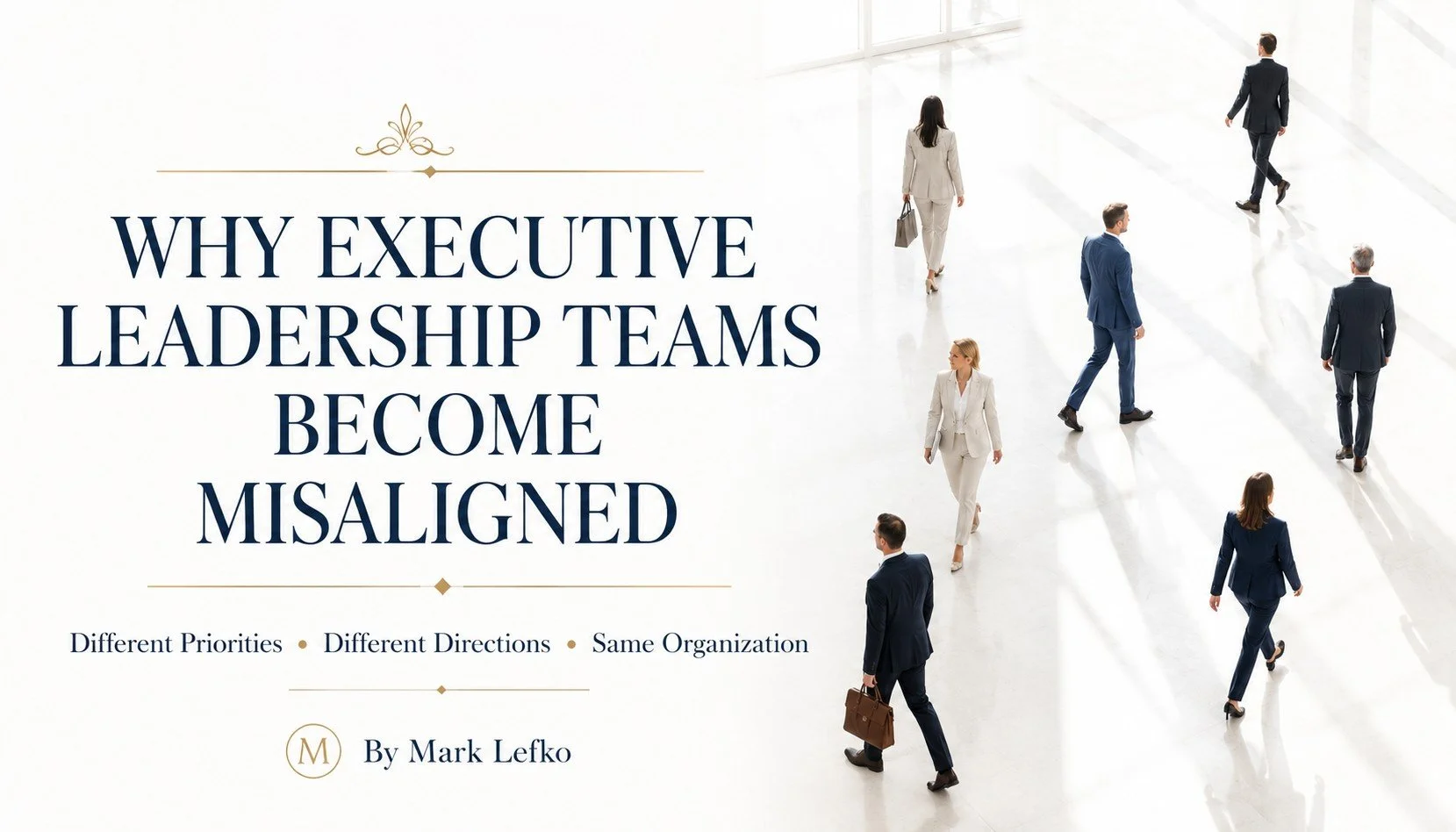
Most organizations do not struggle because they lack talented people. In fact, many Executive Leadership Teams are made up of highly capable, experienced, and committed leaders.
Yet despite their talent and good intentions, leadership teams often become misaligned. Communication becomes more difficult. Departments begin operating independently. Trust weakens. Meetings become less productive. Decisions take longer. Execution suffers.
Over the past forty years, I have observed that executive team misalignment rarely occurs suddenly. It typically develops gradually — often while the organization is focused on other things.
The Myth of Alignment
Many leadership teams assume alignment exists because conflict is limited and meetings run smoothly. Unfortunately, the absence of conflict is not the same as alignment.
In some cases, leadership teams become so focused on maintaining harmony that important issues are never discussed openly. Concerns remain unspoken. Assumptions go unchallenged. Disagreements move into hallway conversations rather than conference rooms.
The result is often a leadership team that appears united on the surface but is fragmented underneath — and the gap between appearance and reality tends to widen over time.
One of the most consistent observations I have made over four decades of working with leadership teams is this: the teams that believe they are most aligned are sometimes the ones most at risk. Comfort can mask complacency. Smooth meetings can hide unresolved tension.
Real alignment requires honest dialogue — not just the absence of disagreement.
Why Misalignment Happens
While every organization is different, several common patterns tend to emerge.
Priorities Become Unclear
As organizations grow, new opportunities and challenges emerge. Without ongoing dialogue, leaders can begin pursuing different priorities. Each executive may be acting with good intentions, yet the organization slowly loses collective focus. What was once a shared agenda gradually becomes a collection of individual agendas — each legitimate, but no longer fully aligned.
Communication Breaks Down
Leadership teams operate at a fast pace. Important conversations are postponed. Assumptions replace discussions. Information becomes unevenly distributed. Over time, misunderstandings increase and trust begins to erode. What leaders don’t say to each other directly, they eventually say to others — and that is when misalignment accelerates.
Functional Silos Develop
Most executives are responsible for a specific area of the business. Sales, Operations, Finance, Human Resources, and Technology all have legitimate priorities. When leaders become overly focused on their own function, organizational thinking gives way to departmental thinking.
The warning sign is subtle but important: when leaders in a team meeting are primarily advocating for their own function rather than collectively solving organizational problems, the leadership team has become a collection of executives rather than a unified leadership team. The distinction matters enormously.
Trust Weakens
Trust is built through consistency, transparency, reliability, and honest communication. It strengthens when commitments are honored, when feedback is direct, and when leaders demonstrate genuine respect for one another’s perspectives.
It erodes in the opposite conditions — when commitments are missed, when difficult conversations are avoided, when leaders begin questioning each other’s intentions. Trust rarely disappears all at once. It weakens gradually, through accumulated small moments that are easy to overlook until the damage becomes difficult to repair.
What High-Performing Leadership Teams Do Differently
The strongest Executive Leadership Teams understand that alignment is not a one-time event. It is an ongoing process.
They regularly discuss organizational priorities, strategic direction, team dynamics, decision-making processes, accountability expectations, and areas of tension and concern. Most importantly, they create an environment where honest dialogue is encouraged, healthy disagreement is welcomed, and difficult conversations happen before problems become crises.
They treat alignment the way high-performing athletes treat conditioning — not as something achieved once, but as something requiring continuous attention and investment.
The CEO’s Role
The CEO plays a critical role in creating alignment. Not by having all the answers or controlling every decision — but by creating clarity. Clarifying priorities. Clarifying expectations. Clarifying what matters most.
When leaders have clarity, alignment becomes significantly easier to achieve and maintain. When clarity is absent, confusion fills the void — and misalignment follows.
The most effective CEOs also model the behaviors they expect from their teams. They communicate openly. They address issues directly. They demonstrate trust in others. Leadership teams take their cues from the top, and the CEO’s behavior sets the standard for everyone else.
When Outside Support Helps
Some organizations find it valuable to engage an experienced, objective advisor to help identify the sources of misalignment and facilitate the conversations needed to restore it.
An outside perspective can help surface issues that are difficult to see from within, create structured dialogue that busy leadership teams rarely make time for on their own, and accelerate the process of rebuilding trust and clarity.
This is not necessary for every organization. Many leadership teams address misalignment effectively through their own commitment and discipline. But when misalignment is persistent and internal efforts have not produced the needed results, outside support can make a meaningful difference.
The Bottom Line
Executive team alignment is not achieved through organizational charts, strategic plans, or leadership retreats alone. Alignment is created through trust, communication, clarity, and ongoing conversation.
The most effective leadership teams understand that alignment is not something they achieve once — it is something they continually strengthen. When alignment improves, execution improves. When execution improves, results follow.
Creating clarity, building trust, strengthening alignment, and driving results — that is the work of every high-performing Executive Leadership Team. And it is work that is never fully finished.
RELATED READING
This article builds on themes from two earlier pieces: “The CEO’s Most Important Relationship: The Executive Leadership Team,” on the relationship that most determines organizational success, and “The Hidden Cost of Leadership Team Dysfunction,” on what misalignment actually costs an organization.
