

Alignment Is Not Agreement: What High-Performing Teams Understand
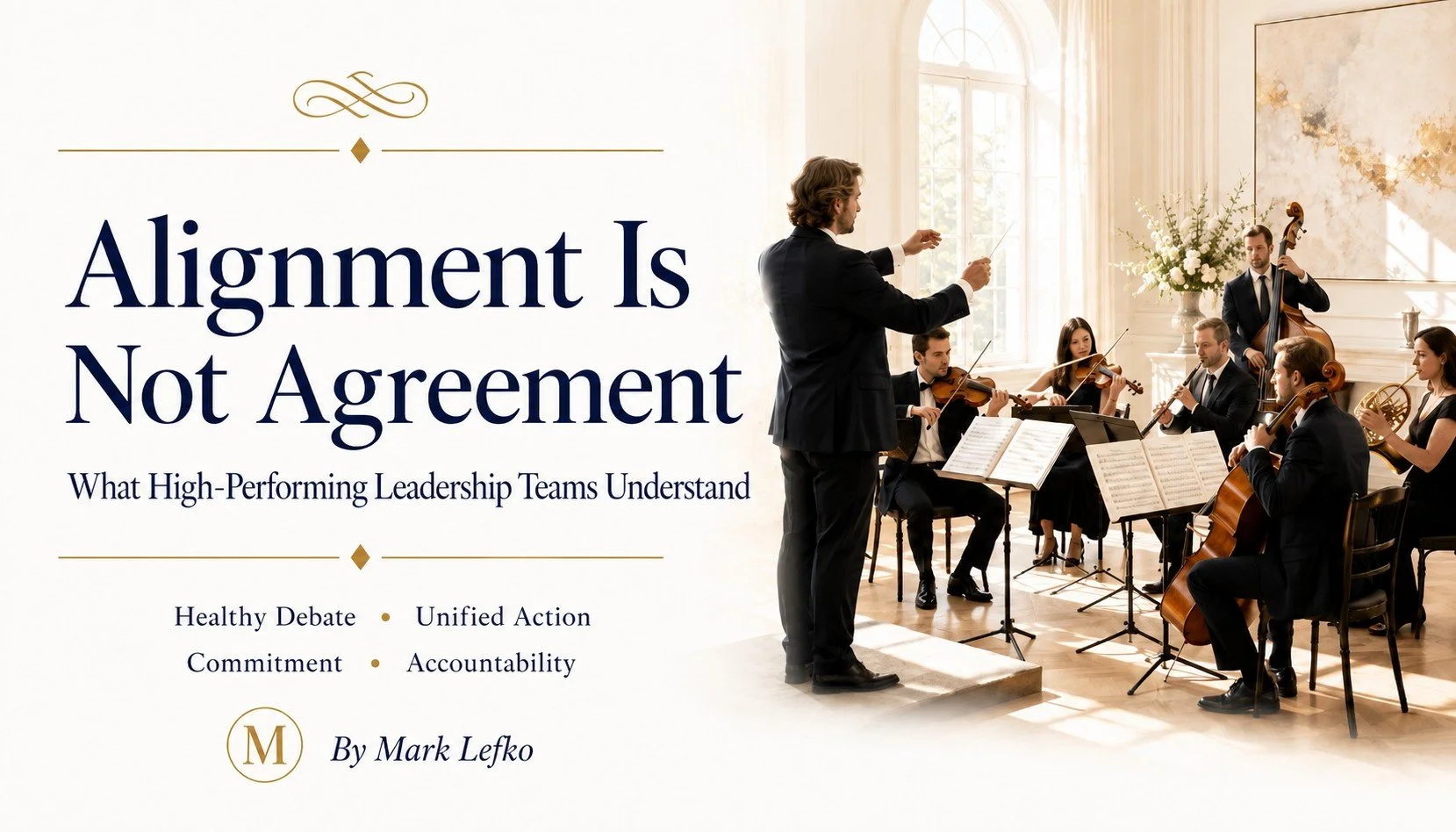
One of the most common misconceptions I encounter when working with Executive Leadership Teams is the belief that alignment means everyone agrees. It does not.
In fact, some of the strongest leadership teams I have worked with over the past forty years frequently disagree with one another. They challenge assumptions. They debate alternatives. They ask difficult questions. They bring different perspectives to important decisions. Yet despite those differences, they remain highly aligned.
The reason is that alignment and agreement are not the same thing. Understanding the difference is one of the characteristics that most reliably separates high-performing leadership teams from average ones.
The Agreement Trap
Many leadership teams unintentionally fall into what I call the agreement trap. Team members become reluctant to challenge one another. Questions go unasked. Concerns remain unspoken. People avoid difficult conversations in an effort to maintain harmony.
Meetings become polite. Decisions appear unanimous. Conflict seems minimal. From the outside, this can look like alignment. Often, it is not. Sometimes it is simply avoidance.
When leaders withhold their perspectives, organizations lose access to valuable information. The result can be weaker decisions, reduced commitment, and hidden frustration. The absence of disagreement should not automatically be interpreted as a sign of health — and some of the most dysfunctional leadership teams I have worked with appeared, at first glance, to be remarkably harmonious.
Healthy Debate Strengthens Alignment
The strongest Executive Leadership Teams understand that healthy debate is an important part of the decision-making process. They recognize that intelligent, committed leaders will naturally see issues differently.
Different perspectives are not a problem. They are an asset.
Healthy debate allows leadership teams to explore alternatives, challenge assumptions, identify risks, improve decision quality, and strengthen strategic thinking. The goal is not to win an argument — it is to arrive at the best possible decision.
When leaders feel safe enough to express differing viewpoints, organizations make better choices.
Alignment Begins After the Decision
One of the most important lessons high-performing teams understand is that alignment begins after a decision is made.
During the discussion phase, disagreement is healthy. After the decision is made, commitment becomes essential.
Leaders may not always agree with every decision. However, once a decision is reached, aligned leadership teams support it collectively. They communicate consistently. They execute responsibly. They avoid second-guessing decisions in front of their teams. They move forward together.
This is where alignment truly matters. Alignment is not about unanimous thinking. It is about unified action.
The Difference Between Consensus and Commitment
Many organizations mistakenly pursue consensus when what they really need is commitment.
Consensus seeks complete agreement. Commitment seeks support.
In complex organizations, complete agreement is often unrealistic. Leadership teams are composed of individuals with different experiences, responsibilities, and perspectives. Waiting for universal agreement can slow decision-making and create frustration.
High-performing teams understand that commitment is often more important than consensus. People do not always need to agree completely — they do need to support the decision once it has been made.
This distinction allows organizations to move faster while maintaining alignment.
Accountability Sustains Alignment
Alignment is not a one-time event. It requires ongoing accountability.
Leadership teams strengthen alignment when they hold themselves and one another accountable for the commitments they make — following through on decisions, supporting agreed-upon priorities, communicating consistently, addressing concerns directly, and avoiding mixed messages.
Without accountability, alignment quickly begins to erode. Even the best decisions lose effectiveness when execution becomes inconsistent. Alignment is ultimately demonstrated through behavior, not words.
The CEO’s Role
CEOs play a critical role in creating an environment where healthy debate can occur. The most effective CEOs encourage diverse viewpoints. They ask questions. They seek input. They remain curious.
Most importantly, they create psychological safety. People are far more likely to contribute honestly when they believe their perspectives will be respected.
Strong CEOs understand that disagreement is not disloyalty. In many cases, it is evidence that leaders care deeply about the organization and its success. The goal is not to eliminate disagreement. The goal is to channel it productively.
When Outside Support Helps
Some organizations find it valuable to engage an experienced, objective advisor to help leadership teams build the discipline of healthy debate followed by unified commitment.
An outside facilitator can create the structured space these conversations require, model the kind of respectful challenge that may not yet be present in the team, and help surface concerns that are difficult to raise internally.
This is not necessary for every organization. Many leadership teams build these capabilities through their own discipline. But when healthy debate has been difficult to establish — or when commitment after decisions has been inconsistent — outside support can make a meaningful difference.
The Bottom Line
Alignment is not agreement. High-performing leadership teams recognize that healthy debate, thoughtful decision-making, and mutual accountability are essential ingredients of organizational success.
The strongest teams are not those that avoid disagreement. They are those that create an environment where differing perspectives can be discussed openly, decisions can be made effectively, and leaders can move forward together.
When leadership teams understand this distinction, trust increases. Decision-making improves. Execution becomes stronger. And the organization benefits from both the wisdom of diverse perspectives and the power of aligned action.
That is what true alignment looks like.
RELATED READING
This article builds on themes from two earlier pieces: “Why Executive Leadership Teams Become Misaligned,” on the gradual ways alignment erodes, and “Building Trust Inside the Executive Leadership Team,” on the foundation that makes healthy disagreement possible.
