

When Leadership Teams Stop Talking: Early Warning Signs - Early Warning Signs of Organizational Trouble
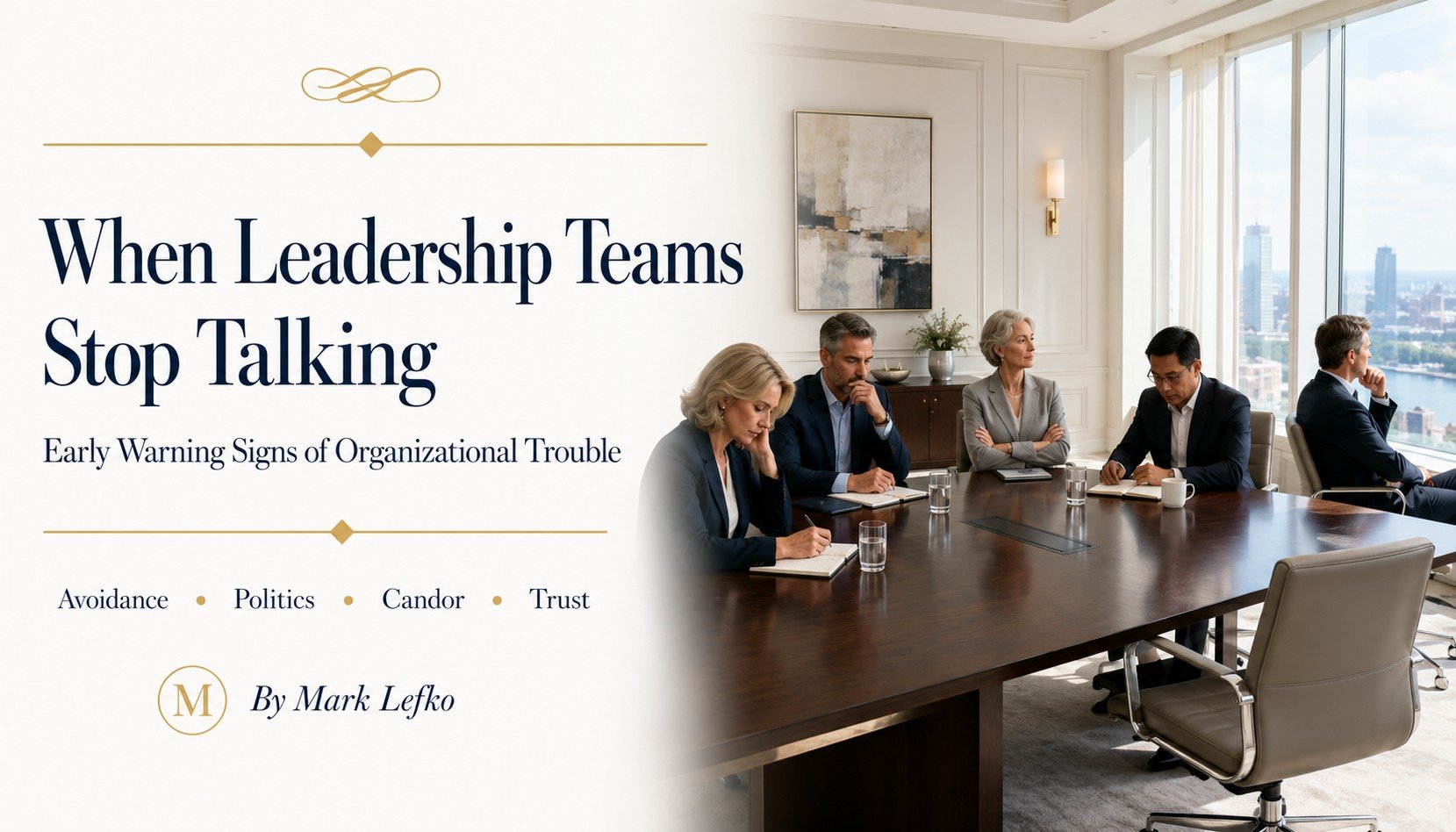
One of the most dangerous moments in an organization rarely appears on a financial statement. It does not show up in quarterly reports. It does not appear on a dashboard. It often goes unnoticed until the consequences become difficult to ignore.
That moment occurs when members of the Executive Leadership Team stop talking openly with one another.
Not literally — meetings still occur, conversations still happen, reports are still exchanged. On the surface, everything may appear normal. But underneath, something important has changed. Candor decreases. Difficult topics are avoided. Concerns remain unspoken. Trust begins to weaken.
In my experience working with CEOs, Presidents, and Executive Leadership Teams over the past forty years, this is often one of the earliest warning signs of organizational trouble — and one of the most consistently overlooked.
What follows are five warning signs that often emerge before the operational symptoms appear, presented roughly in the order they tend to develop.
Warning Sign 1: Avoidance Becomes the Norm
One of the first warning signs is avoidance.
Topics that once would have been discussed openly begin disappearing from leadership meetings. Difficult decisions are postponed. Concerns are raised privately rather than publicly.
Leaders become reluctant to challenge one another. The team begins focusing on safer conversations while avoiding the issues that matter most.
Unfortunately, problems rarely improve when ignored — more often, they grow. What begins as a minor concern can eventually become a significant organizational challenge. And the longer issues are avoided, the harder they become to address.
Warning Sign 2: Politics Begin to Replace Collaboration
As trust declines, organizational politics often increase.
Information becomes more guarded. Leaders become more focused on protecting their departments than advancing organizational priorities. Conversations move outside the meeting room. Decisions are influenced by alliances rather than open discussion.
Most leaders dislike organizational politics. Yet politics often emerge specifically when people no longer feel comfortable addressing issues directly. The less trust that exists, the greater the temptation to influence outcomes through informal channels.
The result is almost always reduced alignment and weaker decision-making — and the organization loses access to the kind of honest dialogue that complex challenges require.
Warning Sign 3: Candor Begins to Disappear
One of the greatest assets any Executive Leadership Team possesses is honest feedback.
When candor declines, valuable information disappears with it. People begin filtering their comments. Questions go unasked. Concerns remain unspoken. Executives start telling one another what they think others want to hear rather than what they genuinely believe.
The organization loses access to important insights — and over time, this creates blind spots that affect strategic decisions, culture, and performance.
Warning Sign 4: Trust Erodes Through Small Moments
Trust rarely disappears overnight. More often, it weakens gradually — through a missed commitment, an unresolved issue, a difficult conversation that never occurs, a perception that concerns are not being heard.
Individually, these events may seem insignificant. Collectively, they begin to change how leaders interact. People become cautious. Assumptions increase. Intentions are questioned.
The team spends more energy managing relationships and less energy solving problems. The shift is subtle enough that leadership teams often do not recognize it until trust has substantially weakened.
Warning Sign 5: The Cost Reaches the Organization
When leadership teams stop talking openly, the consequences eventually extend far beyond the executive suite.
Decision-making slows. Opportunities are missed. Priorities become unclear. Employees receive mixed messages. Departments become less aligned. Customers may eventually feel the impact.
Organizational culture often follows the example set by leadership. If leaders avoid difficult conversations, others are likely to do the same. If leaders stop trusting one another, that behavior often spreads throughout the organization. What begins as a leadership team issue can quickly become an organizational issue.
What Healthy Leadership Teams Do Differently
The most effective Executive Leadership Teams understand that trust and communication require ongoing attention. They create environments where honest dialogue is encouraged, different viewpoints are welcomed, difficult issues are addressed directly, commitments are honored, and accountability is expected.
These teams recognize that disagreement is not the enemy. Avoidance is.
They understand that healthy conflict often prevents larger problems from emerging later — and that the absence of conflict is not necessarily a sign of health. Sometimes it is a sign that important issues are not being discussed.
The CEO’s Role
CEOs play a critical role in shaping the quality of leadership team conversations.
The most effective CEOs create psychological safety. They encourage candor. They invite differing opinions. They model curiosity rather than defensiveness. Most importantly, they demonstrate that difficult conversations are not only acceptable — they are necessary.
When leaders feel safe enough to speak honestly, organizations gain access to the information needed to make better decisions. When they do not, the organization gradually loses that access — often without anyone consciously noticing.
When Outside Support Helps
Some organizations find it valuable to engage an experienced, objective advisor when these warning signs have begun to emerge — particularly when leadership team conversations have become surface-level, when avoidance has become a pattern, or when trust has weakened in ways that are difficult to address internally.
An outside perspective can help surface what is no longer being said within the team, create the structured space honest dialogue requires, and accelerate the rebuilding of trust and candor.
This is not necessary for every organization. Many leadership teams recognize these warning signs early and address them through their own discipline. But when patterns have become entrenched or when internal efforts have not produced the needed change, outside support can make a meaningful difference.
The Bottom Line
Organizations rarely fail because leaders have too many honest conversations. More often, they struggle because important conversations never happen.
When Executive Leadership Teams stop talking openly, avoidance increases, politics emerge, candor declines, and trust weakens. These are often among the earliest warning signs of organizational trouble — and they typically appear long before the operational consequences become visible.
The good news is that trust can be rebuilt. Communication can improve. Alignment can be restored. But it begins with a willingness to have the conversations that matter most.
Because when leadership teams talk openly, organizations perform better. And when they stop talking, the consequences are rarely far behind.
RELATED READING
This article builds on themes from three earlier pieces: “The Hidden Cost of Leadership Team Dysfunction,” on what unhealthy leadership teams actually cost an organization; “Building Trust Inside the Executive Leadership Team,” on the foundation honest conversation requires; and “Alignment Is Not Agreement: What High-Performing Leadership Teams Understand,” on why the absence of disagreement is not the same as alignment.
